

By David A. Freel © David A. Freel, Ashley Creek Publishing, LLC — March 13, 2026
A Career That Blends Security and Adventure
In today’s world, many jobs feel uncertain—threatened by artificial intelligence, economic shifts, or automation. At the same time, millions of people feel a powerful pull toward wanderlust: the deep desire to travel, explore new places, and experience the world.
These two forces—job security and the freedom to roam—don’t have to be in conflict. One of the best places they converge is working for a commercial airline.
Whether you’re in the cockpit as a pilot or in the cabin as a flight attendant, airline crew roles remain remarkably resistant to AI replacement. Human experience, judgment, and real-time decision-making are still essential for passenger safety. Beyond that, these careers often offer competitive pay (especially with seniority), strong union contracts, job security, and one of the greatest perks of all: near-unlimited travel.
Airline Pilot Salary Ranges – 2026 Estimates
| Category / Airline Type | First-Year First Officer (approx. annual) | Tenth-Year Captain (approx. annual) | Notes / Typical Aircraft |
| Regional Airlines | $85,000 – $115,000 | $150,000 – $220,000 | CRJ, ERJ, small turboprops |
| Major Airlines – Delta | $117,000 – $125,000 | $400,000 – $465,000+ | A320, A350, B737, B767/777 |
| Major Airlines – United | $110,000 – $120,000 | $350,000 – $420,000+ | B737, B777, B787 |
| Major Airlines – American | $110,000 – $120,000 | $350,000 – $470,000 | A321, B737, B777 |
| Major Airlines – Southwest | $115,000 – $125,000 | $340,000 – $380,000+ | B737 only |
Approximate 2026 airline pilot pay ranges (first-year First Officer vs. tenth-year Captain). Figures are estimates and vary by airline, aircraft type, hours flown, per diem, bonuses, and overtime. Actual pay can be higher with overtime, profit sharing, and incentives. Source: Summarized from ATP Flight School, Epic Flight Academy, and airline contract summaries (2026 data).
There are several routes to joining an airline crew. The key is preparation. As Louis Pasteur said, fortune favors the prepared mind. Understanding the requirements, building the right experience, and staying committed dramatically increases your chances of turning wanderlust into a rewarding, long-term career.
From the Front Lines to the Flight Line
Dave Templin grew up a military brat. His father flew the F-80, F-84, F-100, and A-7 fighter and attack aircraft. Dave recalls fondly sitting at the end of the runway at Nellis Air Force Base near Las Vegas, Nevada, as a kid, watching fighters take off and land. His dad took him and his brother to gunnery ranges to watch firepower demonstrations, where they sat alongside invited VIPs as the Air Force showcased the latest weaponry. By age eight, Dave knew he wanted to follow in his father’s footsteps.
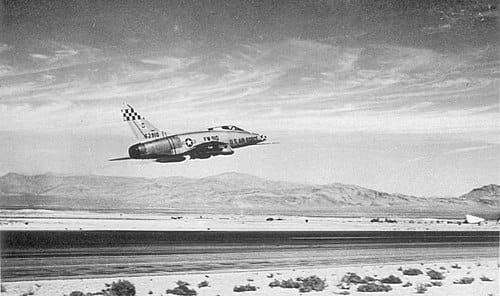
A United States Air Force North American F-100D-60-NA Super Sabre fighter (s/n 56-2910) taking off from Nellis Air Force Base, Nevada (USA), circa 1959 – the kind of scene that inspired Dave Templin as a child. Photo credit: Public domain – United States Air Force (via Wikimedia Commons).
Dave attended Texas A&M University and joined the Corps of Cadets, the university’s Reserve Officer Training Corps program. During his senior year, he applied to become a pilot through the Air Force’s pilot prescreening program. That year, he earned his first 25 hours of flight training in a Cessna 152. Upon earning his BS in Meteorology, he was commissioned as an officer in the Air Force.
Dave was among the best of the best—the top 10% of candidates are selected to fly fighter jets. After completing flight school, he had the privilege of flying the F-4 Phantom II (C, D, and E models) for eight years, accumulating 1,600 flight hours. As the military phased out the F-4, Dave transitioned to the F-16 Fighting Falcon, flying both A and C models and adding another 1,600 hours. He flew numerous combat missions over Bosnia and Iraq.
Dave Templin prepares for a mission at Incerlik Air Base, Turkey. Photo used with permission. Photo credit: © David Templin
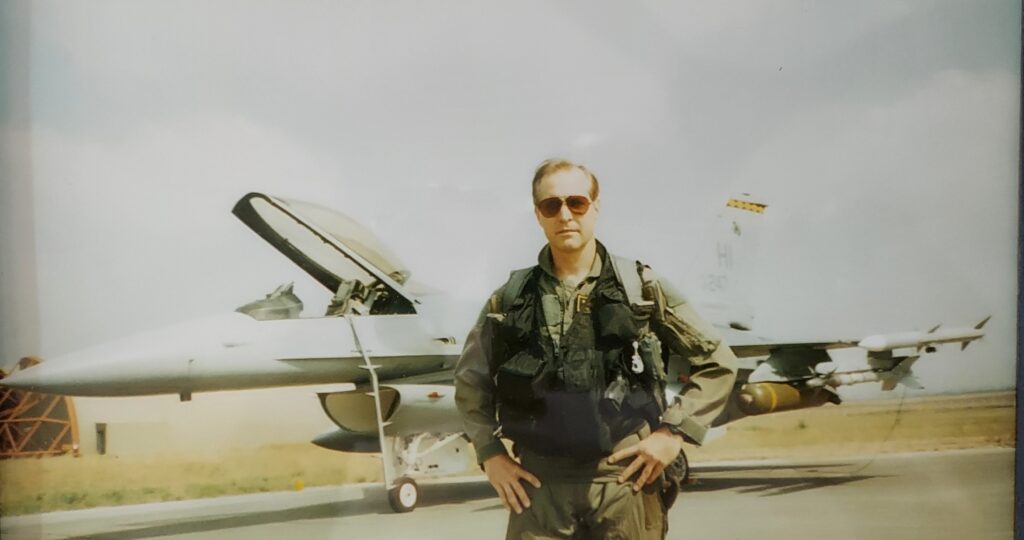
During the 1990s reductions in force, base realignments, and closures, Dave faced career instability in the Air Force. Looking at his options, he applied to all major U.S. airlines and FedEx. Fortune smiled—he was hired by United Airlines and continued flying the F-16 in the Air Force Reserve for another five years. He retired from the Air Force with a combined 22 years of service across active duty, Reserve, and Air National Guard, totaling over 3,350 flight hours.
All that flying experience didn’t make the transition seamless. Fighter-jet pilots bring vast skill and split-second decision-making under pressure, but several civilian certifications are still required. Many military pilots who fly “heavies” (multi-engine cargo aircraft) transition more easily. Dave used his GI Bill benefits to earn his Airline Transport Pilot (ATP) certificate, multi-engine rating, and a type rating on the Boeing 737.
A lighthearted nod to the many pilots who balance airline careers with service in the armed forces reserve. Photo credit: Original cartoon illustration © David A. Freel/Ashley Creek Publishing, LLC
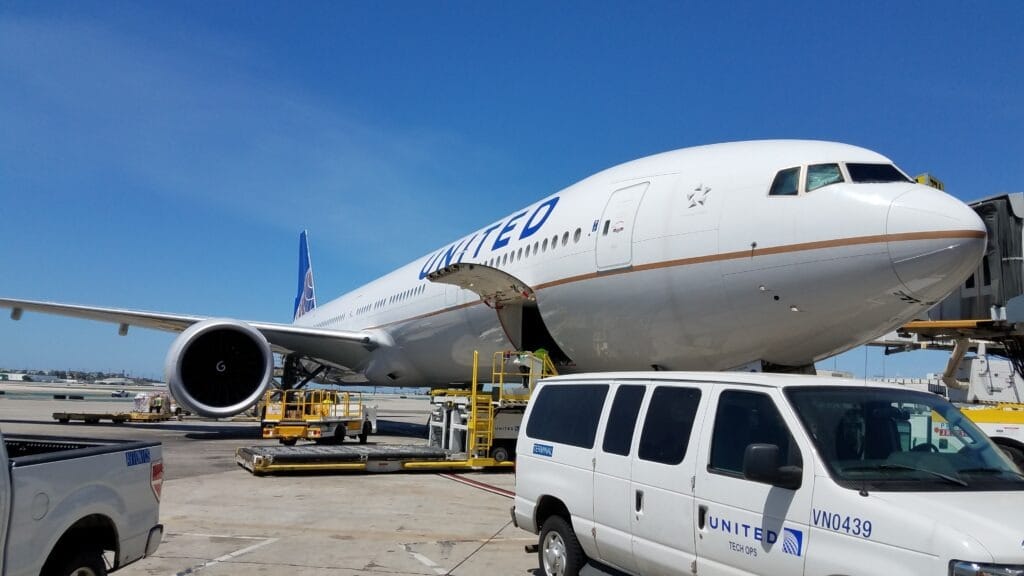
He went on to fly the Boeing 737, 757, 767, 777, and 787 for United Airlines, retiring after 27 years with the airline. All in all, his flying career spanned 47 years. Dave speaks highly and fondly of both military and airline opportunities.
The airlines hire roughly as many civilian pilots as military pilots. According to Dave, civilians are often regional or corporate pilots looking to move up. When airlines hire military pilots, “they get an experienced pilot, usually with over 2,000 hours of pilot-in-command time, and who have a good grasp of crew concept.”
A United Airlines Boeing 777-300 about to depart for Hong Kong. Photo used with permission. Photo credit: © David Templin
The Joy of Travel Is Part of the Journey
After retiring from the Air Force and no longer flying the F-16 on weekends, Dave missed the camaraderie with fellow pilots and crew. The airline gave him some of that back. He loved flying to different cities and countries—some familiar, some new. Layovers with other pilots and cabin crew replaced much of the military camaraderie. Each stop offered chances to try new restaurants and see new sights. He started a bucket list for himself and his family. The airline travel benefits helped him check off most of it—“just a few more countries to go.”
Drive and Determination
Becoming a commercial airline pilot as a civilian takes real effort, patience, and purpose. Steve Johnson, now a First Officer at a regional airline, shares how he built his path outside the traditional military route.
During his senior year at the University of Texas, Steve listened as friends debated post-graduation plans—finance, tech, sales. “The 9-to-5 jobs just didn’t resonate with me,” he recalls.
That same year, Steve’s father—a retired Captain who flew the Boeing 777 for a major U.S. airline—purchased a 1946 Piper J-3 Cub. The bright-yellow, fabric-covered, single-engine antique was powered by a modest 65-horsepower Continental engine. Anticipating retirement and missing flying, Steve’s dad asked him and his older brother (already a pilot) to ferry the Cub from northern California to a small airpark near Austin, Texas.
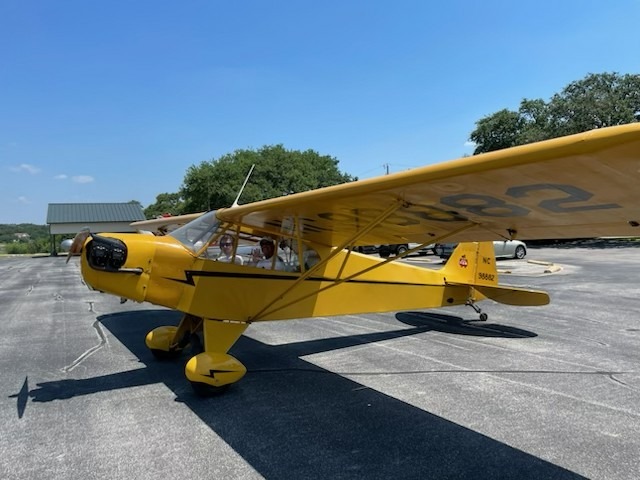
Classic 1946 Piper J-3 Cub, the actual aircraft Steve and his brother flew across four states. Photo credit: © Ashley Creek Publishing, LLC
With spring break giving Steve a full week off, he joined the adventure. Over seven days, the brothers flew south, often shadowing Interstate 10 at roughly the speed of traffic below—some cars even passed them. They crossed four states, navigating mountain passes and desert terrain.
What stood out most to Steve was the meticulous preparation required for safety. Each morning began with performance calculations, weather briefings, and route planning. High-density altitudes from heat and elevation made timing critical. Limited to day VFR (visual flight rules), they flew early and landed by late morning at small, often unpaved desert strips.
They carried only small backpacks—one change of clothes and toothbrushes—because extra weight exceeded limits.
“Landing at these remote fields and operating such a simple aircraft in challenging conditions was a unique experience,” Steve says. “It reminded me of a side of aviation that’s becoming rare—defined not by speed or convenience, but by planning, patience, and appreciation for the journey itself.”
By the time they reached Austin, Steve knew aviation was his calling. Watching his brother’s discipline and skill cemented his decision to join the “family business.”
Buying products using the links in this website provides the support we need to keep providing you with great content. Thank you!
Rotary13B1 Remove Before Flight Key Chain – 3 Pack Red
From First Lesson to Regional Airline
You don’t simply apply to become an airline pilot—you prepare deliberately. After graduation, Steve’s first step was earning his FAA Private Pilot Certificate, learning to fly and maintain a single-engine airplane.
He then enrolled at ATP Flight School in Dallas, earning seven additional certifications and progressing toward commercial ratings.
To qualify for an Airline Transport Pilot (ATP) Certificate—and a job at a regional airline—you need 1,500 hours of flight time across various aircraft. Paths to those hours vary: some pilots pay-to-fly, others take low-paying jobs like banner towing, pipeline patrol, or cargo runs. For some students, scholarships or student loans are available to help with the upfront costs. Many airlines now partner with civilian flight schools with a job waiting after successful completion of all the training and certifications.
Steve chose flight instructing. Teaching students on single- and multi-engine airplanes let him build hours while others covered rental and fuel costs.
“Flight instructing was humbling but formative,” he says. “I learned more teaching than I ever did as a student—especially the importance of constant awareness. The students you’re most comfortable with often put you in the most challenging situations.”
His mother had been a flight attendant with Continental Airlines (later taking an early buyout to raise four children) and then returned and continues to fly with another major U.S. airline. His mother’s long career, his father’s 39-year career as a pilot, his pilot brother a few years ahead of him pursuing a job with the airlines, and the Cub adventure gave Steve strong role models.
From his first flight lesson to his first day at a regional airline, Steve’s journey took three years and two months—about one year earning certificates and ratings, followed by two years instructing.
“Definitely worth the effort and sacrifice,” he says.
Author’s Note The name “Steve Johnson” used in this story is a pseudonym. The individual and his experiences are real. However, at his request, a pseudonym has been used so that he is not seen as speaking for or on behalf of his current or former employer.
Disclaimer Advertisements may appear in this article or on the Ashley Creek Publishing website. This is not necessarily an endorsement of any product or service by the author or Ashley Creek Publishing, LLC.
